Arab baths in Spain: the Andalusian legacy of the hammam
How the Arab baths of al-Andalus worked, what is left of them in Andalusia, and how that heritage shows up in the bathing spaces Spain has today.
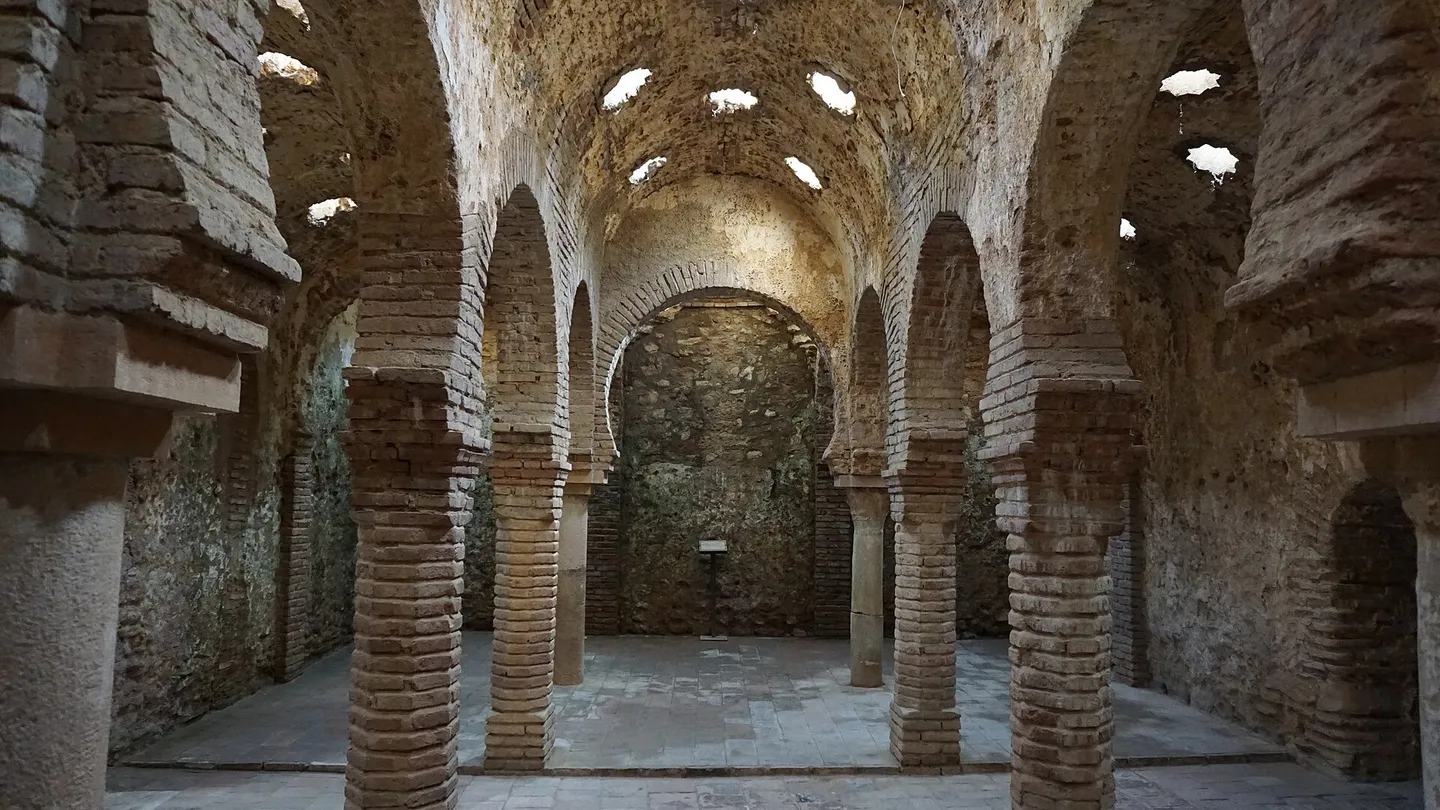
Photograph: Julia Kostecka, CC BY 2.0, via Wikimedia Commons
.jpg)
For almost eight centuries, much of the Iberian Peninsula was al-Andalus, the Muslim-ruled territory that at its height covered nearly all of present-day Spain and ended with the fall of Granada in 1492. Every Andalusi city had its public baths, the hammam, which Spaniards call the baño árabe, the Arab bath.
Some of those buildings survived whole, hidden under palaces, turned into laundries or tanneries and rediscovered in the twentieth century. Others are known only from excavation. Since 1998, Spain has also had new bathing spaces that present themselves as heirs to that tradition.
This guide explains how the Andalusi bath worked, where to see what is left of it in Andalusia, and what today’s spaces take from the old model.
A building inherited from Rome, at neighborhood scale
The Arabs did not invent the public bath. The model came from the Roman baths, and the official Junta de Andalucía leaflet on the baths of Baza sums up the change: the hammam standardized the floor plan and shrank those complexes, keeping the three Roman water rooms (frigidarium, tepidarium and caldarium) and the vaults.
The difference in scale is what matters. Rome’s great thermae were imperial works with pools and gardens (the post on the Roman baths tells that story). The Andalusi bath was a neighborhood building, with no swimming pool, built so that the people nearby could wash often.
The exhibition Baths in al-Andalus, mounted by the Legado Andalusí in Granada in 2019, records two things: the bath was one of the first buildings in a new settlement, and a city’s importance was measured by how many baths it had. For Caliphal Córdoba in the tenth century, the chronicles give about 300. Tourist guides repeat 600 or 900, with no primary source. None of these figures was counted by archaeologists, so treat them as orders of magnitude.
The rooms, in the order of a visit
Sources on the Andalusi baths use the Arabic names of the rooms. The Patronato de la Alhambra describes the sequence in the Comares bath, and the same order appears at Baza, Ronda and the Bañuelo in Granada.
- Bayt al-maslaj. The entrance and rest room, where the bather left their clothes. It usually had a latrine and a fountain. It was also where the visit ended.
- Bayt al-barid. The cold room: a small space, almost a passage, with a basin of cold water.
- Bayt al-wastani. The warm room, literally “the middle one”, and the largest in the building. It was where people spent most of their time, sitting on the benches and talking.
- Bayt al-sajun. The hot room, with one or two basins of water heated by the boiler.
- Service area. The furnace (al-furn), the boiler (al-burma) and the woodshed, with its own door for whoever fed the fire. The bather never saw this part.
The heat came from below. The floor of the hot room rested on brick pillars, and hot air from the furnace ran through that void, as in the Roman hypocaust. Water thrown on that floor made the steam that filled the hot room and, more weakly, the warm one. The Andalusi bath was a steam bath, not an immersion bath: the water sat in basins and was poured over the body.
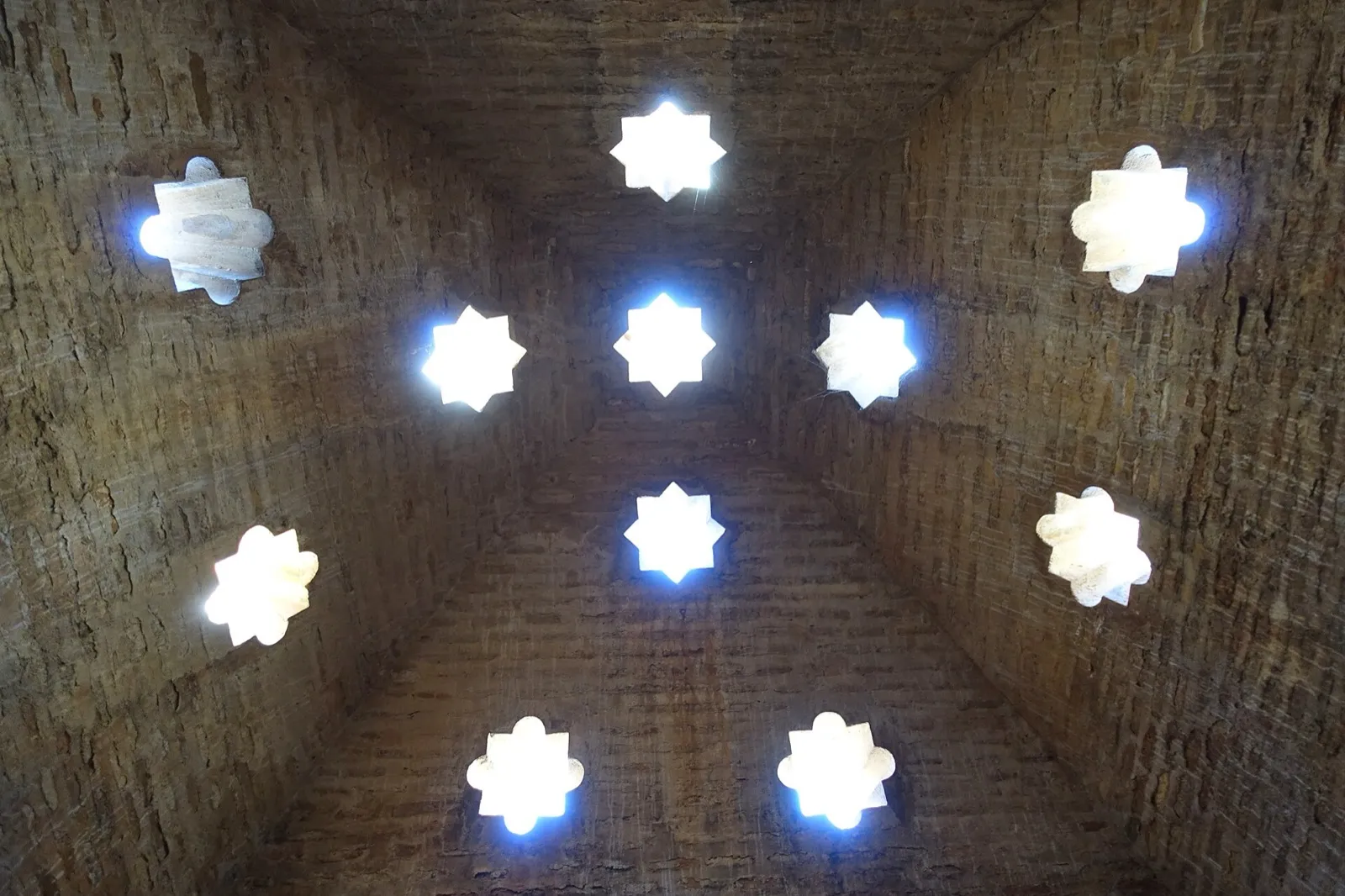
Vault of the Comares baths in the Alhambra: the star skylights were opened or closed from outside to control the steam. Photograph: Daderot, public domain, via Wikimedia Commons.

The skylights are the most recognizable mark of these buildings. The vaults of the steam rooms are pierced by small openings shaped like stars or flowers. According to the Patronato de la Alhambra, attendants opened or closed the small outer windows to regulate the steam. It was the same job as the bronze disc Vitruvius told builders to hang in the Roman dome: controlling temperature without a thermometer.
A city service, tied to the mosque
The bath stood near mosques, city gates and main streets. Many belonged to mosques, and the rent helped pay for worship. The Bañuelo in Granada, for example, was owned by the neighboring mosque and supported it with its income, according to the University of Granada.
The bath was not only for washing. The Baza leaflet lists haircutting, hair removal and massage among its services, and describes the building as a meeting place.
Islam prescribes ritual washing, including ghusl, the washing of the whole body, and the public bath was one place with hot water to do it. The Baza leaflet opens with a verse of the Quran about water and describes the bath as what cleanses the body and, before it, the spirit.
After the conquest: laundry, tannery, basement
The baths did not close the day each city passed to the Christian kingdoms. Those in Jaén, taken by Castile in 1246, kept working for the first years, according to the Andalusia tourism portal. The Legado Andalusí records that the baths stayed in use until the sixteenth century.
Christian kings also built baths on the Andalusi model. In Córdoba, Alfonso XI had the royal baths of the Alcázar de los Reyes Cristianos built in 1338. In Valencia, outside Andalusia, the Banys de l’Almirall were licensed in 1313, repeat the sequence of vestibule and three vaulted rooms, and operated as a public bath until 1959.
The break came with the pragmatic sanction of Philip II, signed in 1566 and published in Granada on January 1, 1567. The decree banned the language, dress and customs of the Moriscos, Muslims forcibly converted to Christianity, and, in historian Julio Caro Baroja’s summary, ordered that they not bathe in artificial baths and that the existing ones be destroyed. The response was the Alpujarras rebellion (1568 to 1571).
The buildings that survived found other uses. The Bañuelo became a public laundry in the eighteenth century. The baths of Jaén and Ronda became tanneries. Those in Jaén ended up in the basement of a palace built on top of them at the end of the sixteenth century. An article in the Cuadernos de la Alhambra (1974 and 1975) records that the Comares bath was the only one in Granada and the Alhambra to survive almost complete, and the only one that never changed use.
What is left in Andalusia
| Bath | City | Date | What you see | Visiting |
|---|---|---|---|---|
| El Bañuelo | Granada | 11th century | Warm room with arches on reused columns and star skylights | Open, on the Carrera del Darro |
| Comares bath | Granada (Alhambra) | 14th century | Decorated rest room, steam rooms, furnace and boiler | Rooms closed to the public; seen from outside, through openings |
| Baths of the Caliphal Alcázar | Córdoba | 10th century | Rooms of the bath of the caliphs’ palace, later remodeled by the Almoravids and Almohads | Museum since 2006 |
| Arab baths of Jaén | Jaén | 11th century | About 450 m², in the basement of the Villardompardo Palace | Open, inside the palace |
| Arab baths of Ronda | Ronda | 13th and 14th centuries | The three rooms, the boiler and the water system with waterwheel and aqueduct | Open, by the Puente Viejo |
| Arab baths of Baza | Baza | 13th century | Cold, warm and hot rooms, furnace, boiler and woodshed | Open; restored by the Junta in 2008 |
Dates and visiting status are those published by the heritage and tourism bodies cited. Hours change, and Comares depends on the Alhambra ticket.
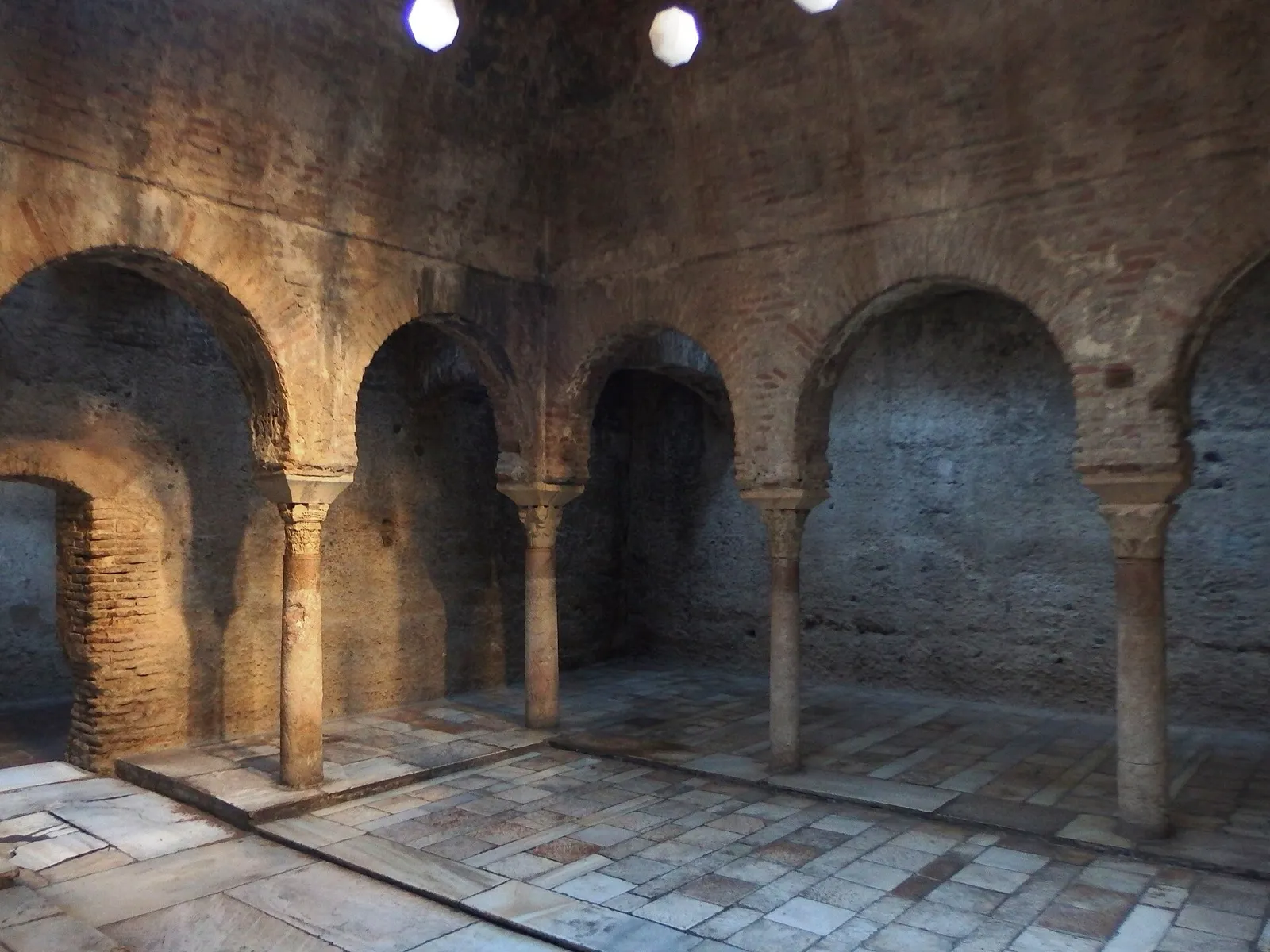
The warm room of the Bañuelo in Granada, built in the eleventh century and used as a laundry after 1567. Photograph: Palickap, CC BY-SA 4.0, via Wikimedia Commons.
.jpg)
El Bañuelo, on the bank of the Darro river below the Alhambra, is now managed by the Patronato de la Alhambra. It was built during the reign of the Zirid emir Badis (1038 to 1056) and was called hammam al-Yawza, the Walnut Tree bath. In the twentieth century, the architect Leopoldo Torres Balbás secured the expropriation of the building and removed the laundry tank from the main room. The column capitals are Roman, Visigothic and Caliphal, reused from older buildings.
The baths of Jaén were built in the eleventh century and remodeled at the end of the twelfth. They stayed hidden under the Villardompardo Palace until 1913, when Enrique Romero de Torres found part of them while compiling the province’s monument catalog. At about 450 m², they are among the largest Andalusi baths open to visitors.
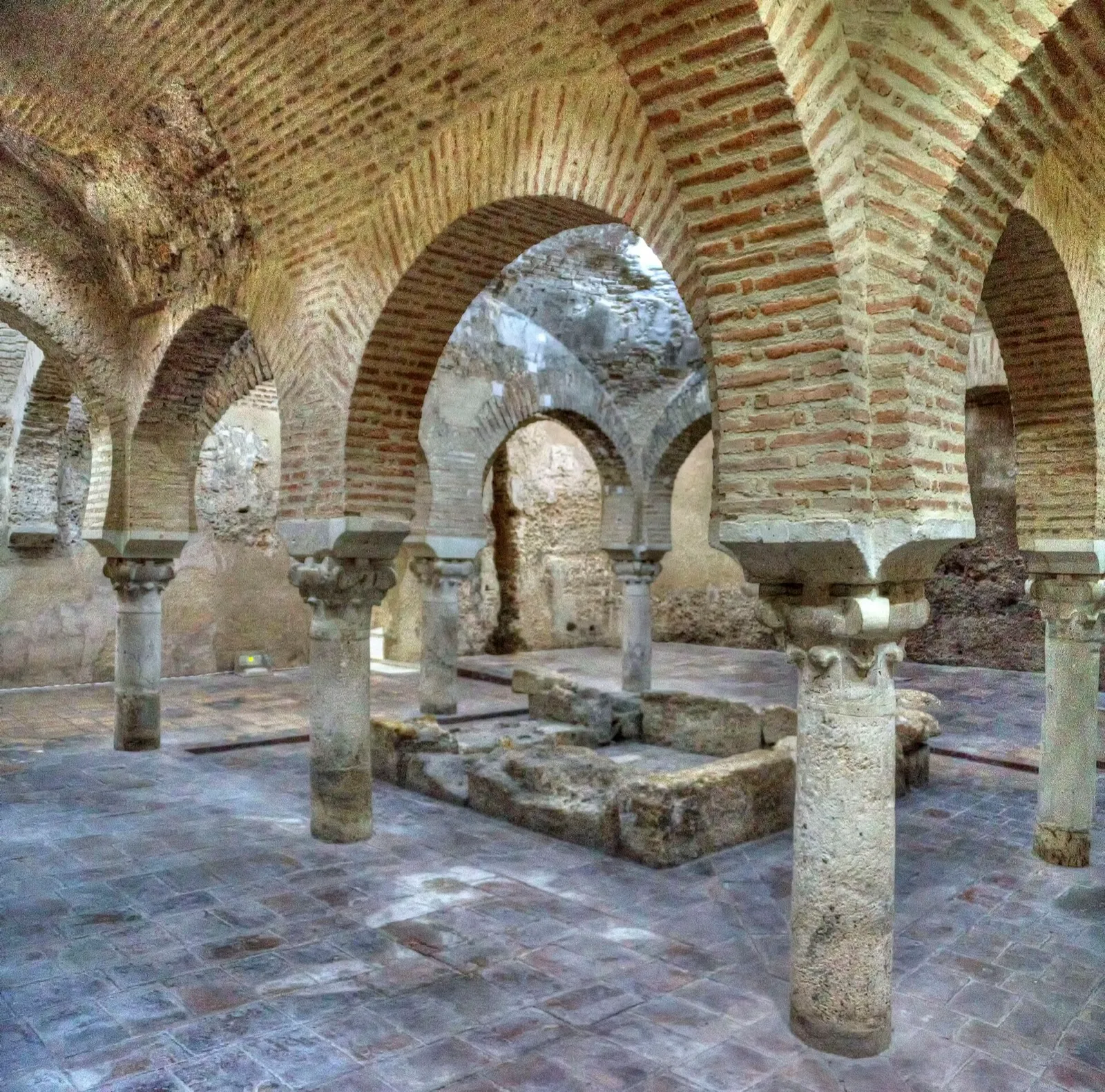
The warm room of the Jaén baths, under the Villardompardo Palace. Photograph: Ángel M. Felicísimo, CC BY 2.0, via Wikimedia Commons.
.jpg)
The baths of the Caliphal Alcázar in Córdoba were commissioned by al-Hakam II (961 to 976) at the western end of the caliphs’ palace. The Andalusian heritage inventory records at least 44 rooms in the complex. The systematic excavations date from the twentieth century, and the site opened as a museum in October 2006.
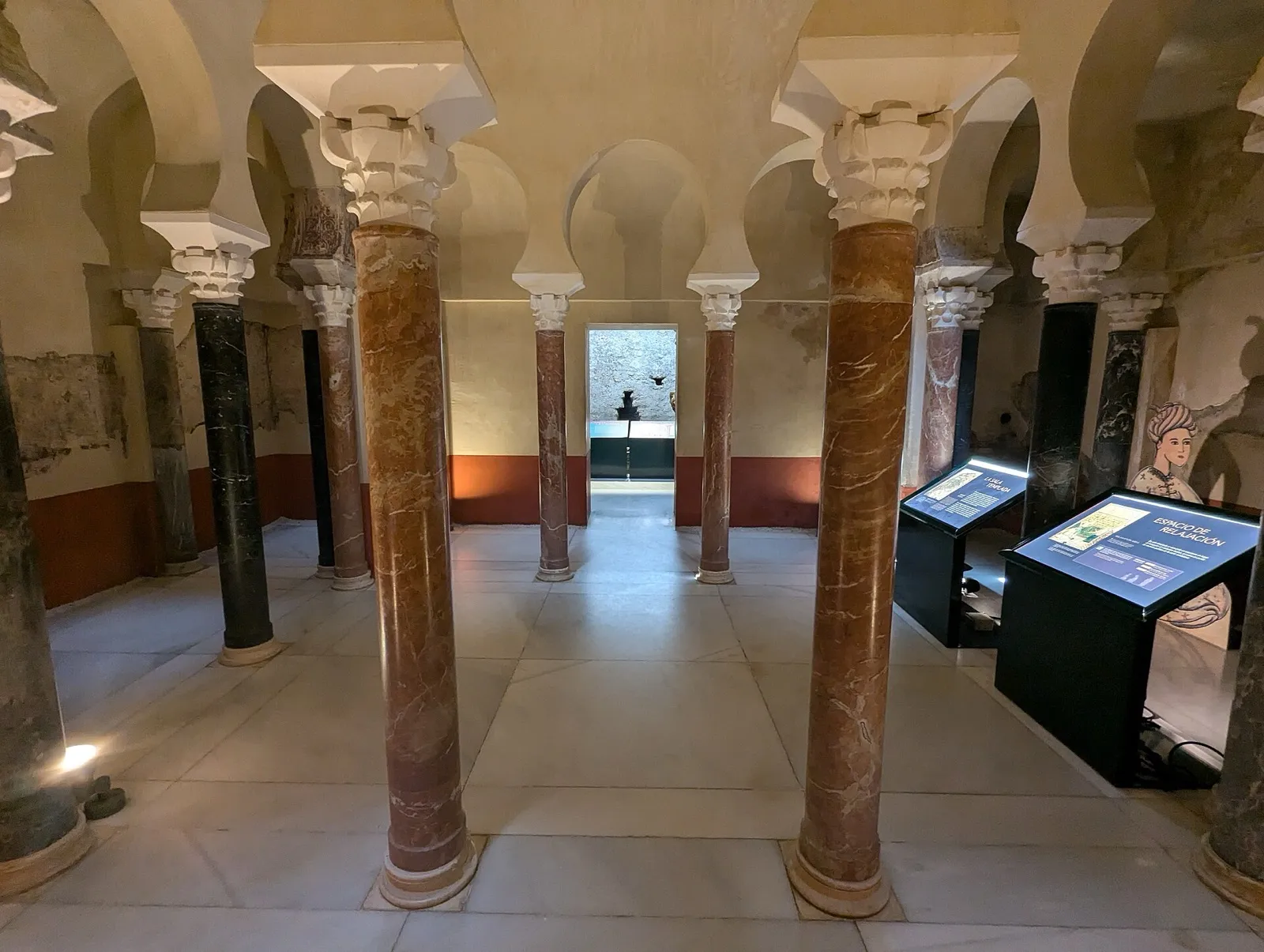
The baths of the Caliphal Alcázar in Córdoba, now a museum. Photograph: Rodelar, CC BY-SA 4.0, via Wikimedia Commons.

The baths of Ronda stand by the Puente Viejo, near where the Culebras stream meets the Guadalevín river. The Junta de Andalucía describes them as one of the best-preserved baths on the peninsula and notes that the water system survived almost whole: a waterwheel lifted water from the stream to an aqueduct that fed the building. The central room has three sections divided by four pairs of horseshoe arches on brick and stone columns.
How the heritage shows up in today’s spaces
The spaces in Spain that now use the name baño árabe or hammam are not the medieval buildings, which are museums. Some stand on sites where old baths once were, but the circuits are new construction that adopted the vocabulary and part of the sequence.
The first was Hammam Al Ándalus in Granada, opened in 1998 behind the church of Santa Ana, below the Alhambra. The Andalusia tourism portal describes it as the first bath of its kind to open in Spain in five centuries. The group now lists locations in Granada, Córdoba, Málaga, Madrid and Palma.
AIRE Ancient Baths started in Seville in 2004 and occupies a sixteenth-century Mudéjar-style palace house there, in the Santa Cruz quarter. In Spain the brand also lists Almería, Barcelona and Vallromanes, plus locations in other countries. The Seville booking page publishes the circuit temperatures in Fahrenheit: caldarium at 102 °F (about 39 °C), tepidarium at 97 °F (about 36 °C) and frigidarium at 57 °F (about 14 °C), plus a jet bath, a steam room and a saltwater flotarium.
What these spaces take is the sequence of temperatures and the names: Hammam Al Ándalus uses the Andalusi reference, and AIRE gives its rooms the Latin names of the Roman baths. What changes is the medium. In the medieval bath the heat was in the air, and the water sat in basins. In today’s spaces the heat is mostly in the water: the three rooms became three pools, and steam has a room of its own. Both operators sell massages separately from the circuit.
| Andalusi bath (10th to 15th centuries) | Today’s baño árabe | |
|---|---|---|
| Heat source | Wood furnace under the hot room’s floor | Heated pool water and a steam generator |
| Sequence | Entrance, cold, warm, hot, back to rest | Warm, hot and cold pools in any order, plus a steam room |
| Water | In basins, poured over the body | Immersion pools |
| Owner | Often the mosque, which lived on the income | Private companies |
The Bathhouse map lists spaces from both groups in Spain with what each operator publishes about format and access.
What to look for on a visit
Visitors to the medieval baths find empty rooms. A few details help read the building:
- The skylights. Star or flower openings mark the steam rooms. At Comares, the entrance room has a central lantern.
- The size of the rooms. The largest is almost always the warm room, where bathers spent the most time.
- The path of the fire. The furnace and woodshed sit on the side opposite the entrance, with their own access, like a plant room. At Ronda and Baza that area survives.
- The reused columns. At the Bañuelo, capitals from different periods stand in the same room.
Next step: read Hammam: what it is, how the bath works and where it comes from to see how the format carried on in North Africa and Turkey, or open the Bathhouse map to find bathing spaces in Spain.