Hammam: what it is, how the bath works and where it comes from
The hammam is the public bath of the Islamic world: heated rooms, hot marble, washing and a scrub. See the sequence of a visit, the Roman inheritance and why the European “Turkish bath” is something else.
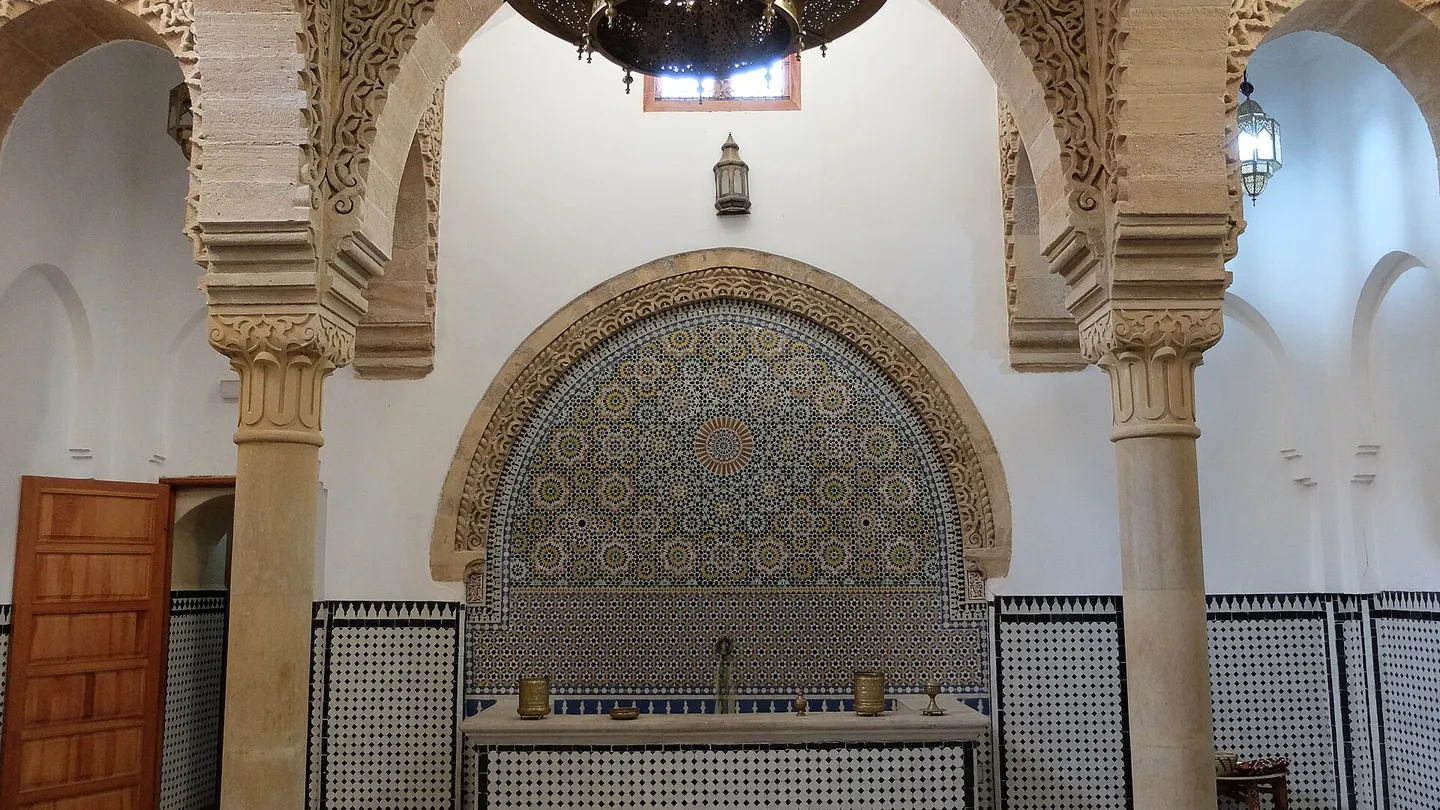
Photograph: R Prazeres, CC BY-SA 4.0, via Wikimedia Commons

The hammam is the public bath of the cities of the Islamic world, from Morocco to Iran. The word comes from Arabic, from a root connected with heat, and Mikkel Aaland translates it in Sweat (1978) as “spreader of warmth”. In English the format became known as the Turkish bath, a name that in nineteenth-century Europe came to describe a very different room.
This guide describes what happens during a visit, where the building comes from and how to tell a hammam from a tiled steam room. The main sources are three books: Sweat, by Aaland; Sauna finlandesa, by Timo Aaltonen (Edicon, 3rd edition, 2015); and Be Well, published by gestalten.
What a hammam is
A traditional hammam is a sequence of rooms of rising temperature, with the floor and walls heated from below. The bather washes with water poured from bowls rather than by immersion. The scrub and the massage are given by an attendant, the tellak, on a heated marble platform.
Three traits set the format apart from other heat baths:
- The water runs, and nobody soaks. Aaland and Aaltonen record that furnace-heated hammams had no pools or tubs, because bathing in standing water was considered unhygienic.
- Washing is part of the bath. Soap, scrub and rinse happen inside the hot room, in front of the other bathers.
- The building belongs to the city. According to both authors, hammams usually stood next to mosques and served the purification that religion required, as well as hygiene and company.
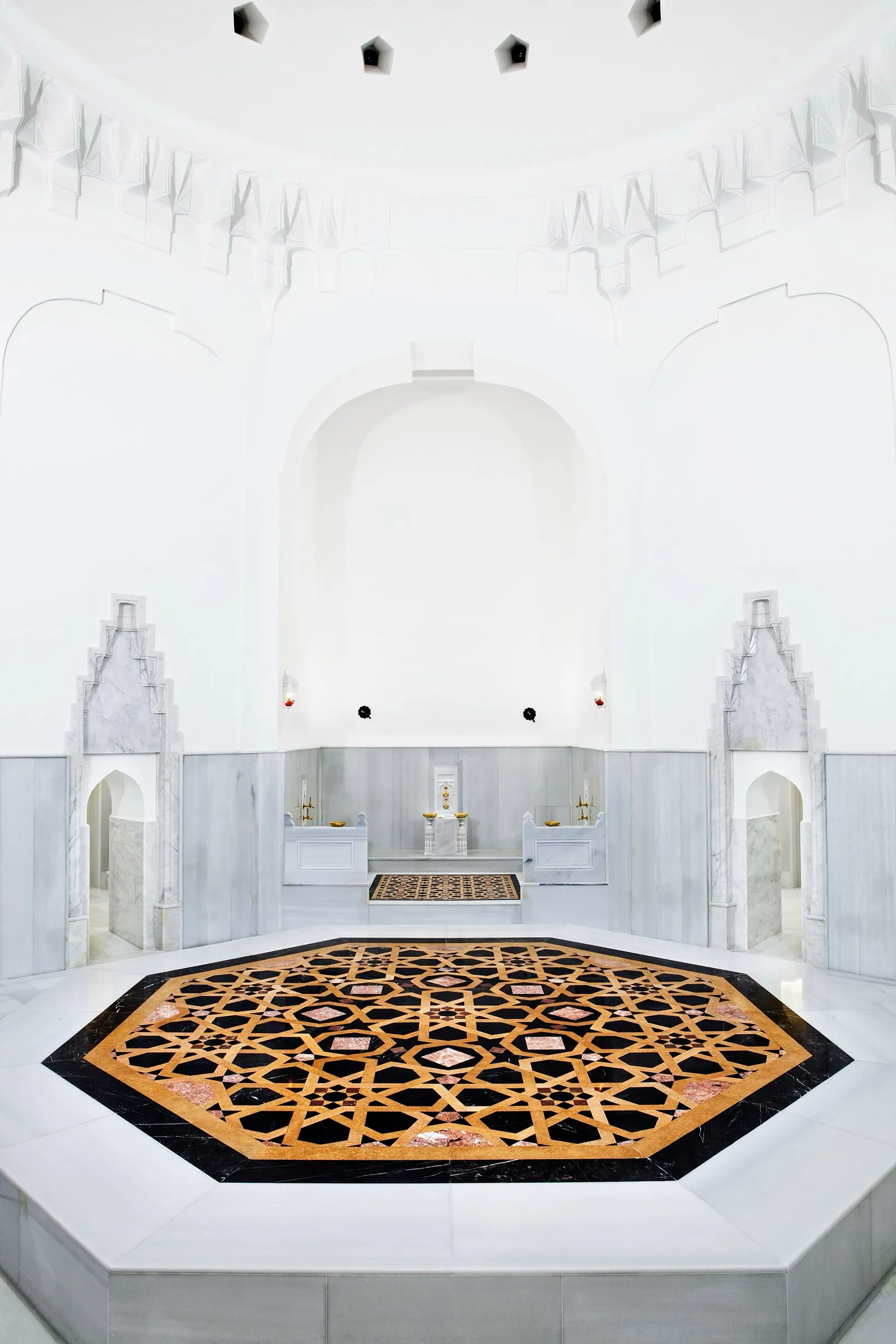
The hot room of the Hürrem Sultan Hamamı in Istanbul: at the center, the heated marble platform where the bather lies down. Photograph: Satayman, CC BY-SA 3.0, via Wikimedia Commons.

The sequence of a visit
The order varies from one house to another. The description below follows the one in Be Well for a hammam with an attendant.
| Stage | What happens |
|---|---|
| Changing room | The bather changes into the peştemal, a thin cotton cloth |
| Warm room | The body adjusts to the heat before the next room |
| Hot room | The attendant applies a paste-like soap made from olives |
| Scrub | The skin is rubbed with the kessa, a rough-textured mitt |
| Heated stone | Lying on the marble platform, the bather receives the foam massage |
| Rinse | Warm or cold water is poured over the body |
| Rest | Tea and repose until body temperature comes down |
The same book points to two regional differences. In a Turkish-style bath the room is heated by hot, dry air, and the rest usually comes with black tea, fruit and sweets. In the Moroccan style the heat comes from hot water running through pipes, and the tea is mint. In public hammams such as the Dar El-Bacha in Marrakech, bathers can bring their own soap and mitt and wash themselves.
Men and women use separate areas or separate hours. The rule about keeping the cloth on changes from house to house, and Türkiye’s official tourism portal describes the local custom.
From Rome to the hammam
The hammam descends from the Roman baths. Aaland recounts that the Arabs encountered Greek and Roman baths in Syria and adapted them, and he places the spread of the format from the seventh century onward. The oldest, he writes, were built by the Umayyad caliphs outside the cities, and one of them is Qusayr ‘Amra, in present-day Jordan.
The heating system stayed the same: the hypocaust, in which hot air from the furnace passes under the floor and inside the walls. The history of the Roman baths explains the mechanism. What changed was the program:
| In the Roman thermae | In the hammam, according to Aaland |
|---|---|
| Large central complexes | Several small buildings spread across the city |
| Tepidarium as the main room | Warm room reduced to a passage |
| Laconicum, the dry sweat chamber | Small steam room beside the hot room |
| Cold plunge at the end | Rest on couches in the entrance hall |
| Exercise yard and library | Massage in the hot room |
Where there were hot springs, the design was different. Aaland describes the hammams called kaplıca or ılıca, in which a pool of running hot water takes the place of the marble platform, and he names those of Bursa among the oldest.
Be Well places the peak of the format in the Ottoman Empire, from the fourteenth century, when hammams spread through the conquered territories. Some buildings from that period are still in use. The Cağaloğlu Hamamı in Istanbul dates from 1741.
A place to meet the city
Aaland describes the hammam as one of the few places open to everyone, from early morning until late at night, with a low entrance fee. Cleanliness was regulated by law, and an inspector checked the washing of the rooms and the quality of the water. Treating a friend to a bath was a habit comparable to arranging lunch.
For women, the hammam was for centuries the main occasion for company outside the home. Aaland records that women’s access was granted gradually, that a visit could last all day, with food brought from home, and that mothers observed prospective brides for their sons there.
Everyday use declined with piped water. Aaland dates the beginning of the decline to the mid-nineteenth century, when wealthy patrons withdrew, and Be Well points to the period after the First World War, with the end of the Ottoman Empire and the arrival of the bathroom in the home.
The European “Turkish bath” is a different room
The name Turkish bath, as used in Europe and the Americas, comes from a nineteenth-century adaptation. Aaland recounts that David Urquhart promoted the hammam in Britain around 1850, that the physician Richard Barter built a hot, dry-air version in Ireland in 1856, and that in 1862 a company headed by Urquhart was formed to build the baths on Jermyn Street in London. Barter’s version circulated under the names Turkish-Roman bath and Roman-Irish bath.
In Brazil, according to Aaltonen, the steam-heated Turkish bath was the most common hot bath until the middle of the twentieth century, installed mostly in luxury hotels, and it ended up being called a “wet sauna”. The piece on the wet sauna myth deals with that confusion, and the one on Spa Colmegna in Buenos Aires shows a house founded in that period.
Hammam, steam room and sauna
| Format | Where the heat comes from | Role of water | Who leads |
|---|---|---|---|
| Hammam | Heated floor, walls and stone | Poured over the body to wash and rinse | The attendant or the bather |
| Steam room | A generator that injects steam | Only in the air, as steam | Nobody |
| Finnish sauna | A stove with stones | Thrown on the stones to make löyly | The bather |
A tiled room with a steam generator is a steam room. To find out whether a venue offers a hammam, ask whether there is a heated room with a stone or platform, whether washing and a scrub are part of the session and who leads them. For dress and conduct in shared baths, see the guide to communal bathing.
Cautions
The hammam combines humid heat, a vigorous scrub and a change of temperature. Anyone with cardiovascular disease, uncontrolled blood pressure, a history of fainting, a pregnancy or a skin condition should talk to a health professional before visiting. Drink water, tell the attendant if the scrub is too strong and leave the hot room if you feel dizzy or unwell.
Next step: read Bathhouse, spa, recovery and hot springs to place the hammam among the other formats, or open the Bathhouse map to find bathing spaces.