The social side of the bathhouse: bathing was always public
Heat and cold became a solo session with a booking slot. For thousands of years bathing was the opposite of that: a public room where people stayed. What heat does to conversation, what the research supports, and the design decisions that settle whether anyone talks.
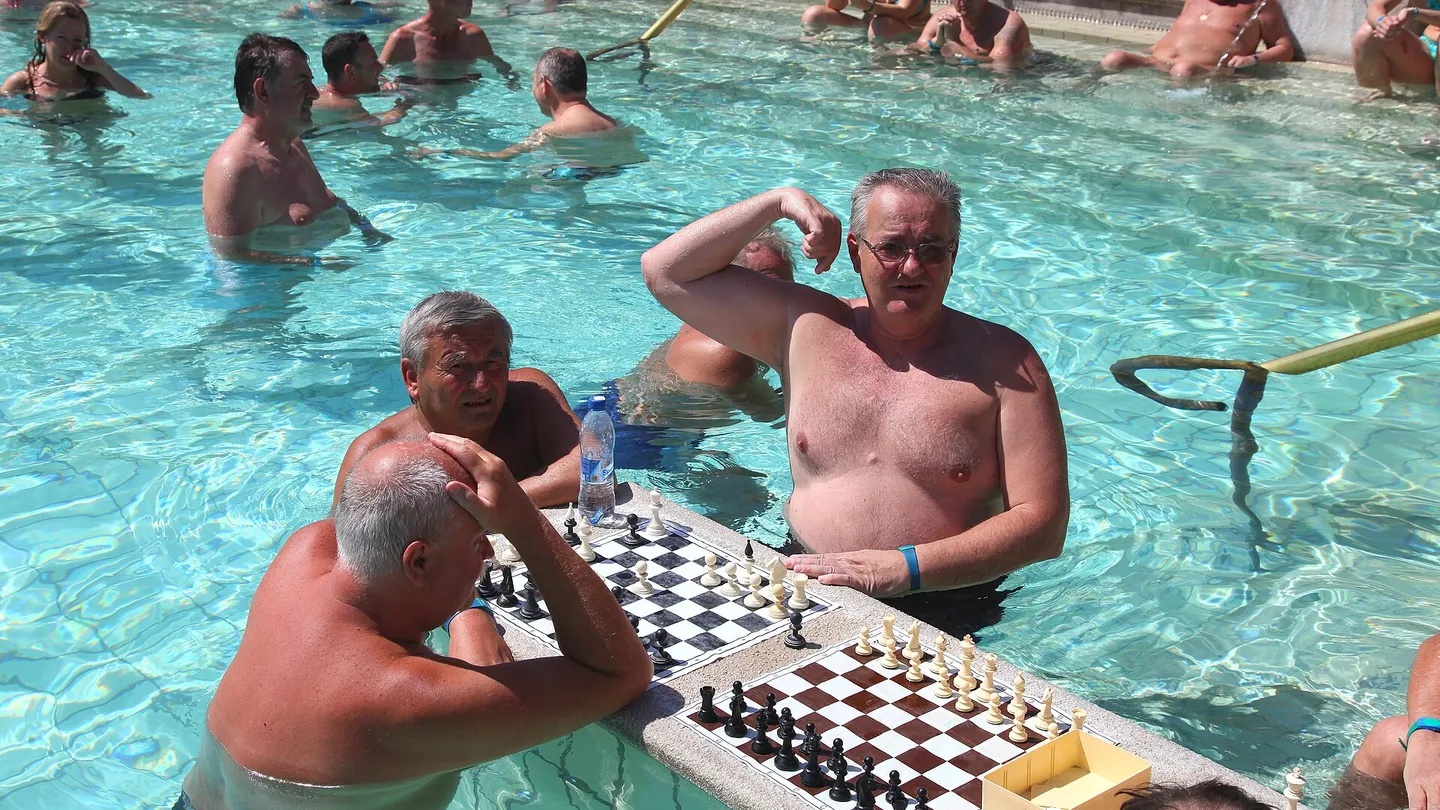
.jpg)
Most of what is sold as bathing today is a solo session. Sixty minutes, a booking slot, headphones in, sauna and ice in sequence, goodbye. It works well, and it is a recent invention. In the history of bathing it is the exception.
For thousands of years the bathhouse was a public address with opening hours and regulars. People went to get clean, and stayed for another reason: it was where everyone was. The heat was the pretext. The room was the product.
This piece is about that part: what the hot room does to conversation, what the research supports (and what it does not), and which design decisions settle whether your bathhouse will have talk in it or the silence of a waiting room.
Bathing was social infrastructure before it was wellness
In Rome, bathing was a daily, cheap habit. The fourth-century regional catalogues list eleven thermae and roughly 850 balnea in the city, and entry cost a quadrans, the smallest bronze coin in circulation. The great imperial thermae were not only hot rooms: they had an exercise yard, gardens, a library and shops. This was urban equipment, like a square or a market. The mechanics of the building are in Roman baths: how the thermae actually worked.
The pattern repeats far from Rome, with different equipment and the same function.
In Finland, Rajaportti, in Pispala, Tampere, is the oldest public sauna still operating in the country. It opened in 1906 under Hermanni and Maria Lahtinen, is still wood-fired, has separate men’s and women’s sides, and shares its building with a coffee house and a masseur. Since 1989 the neighborhood sauna association has run it. This is not a tourist attraction that grew a neighborhood around it: it is a neighborhood that never stopped having a sauna. In December 2020 UNESCO inscribed sauna culture in Finland on the intangible cultural heritage list, with the numbers that explain its weight: some 3.2 million saunas for 5.5 million people, and close to 90% of the population bathing at least once a week.
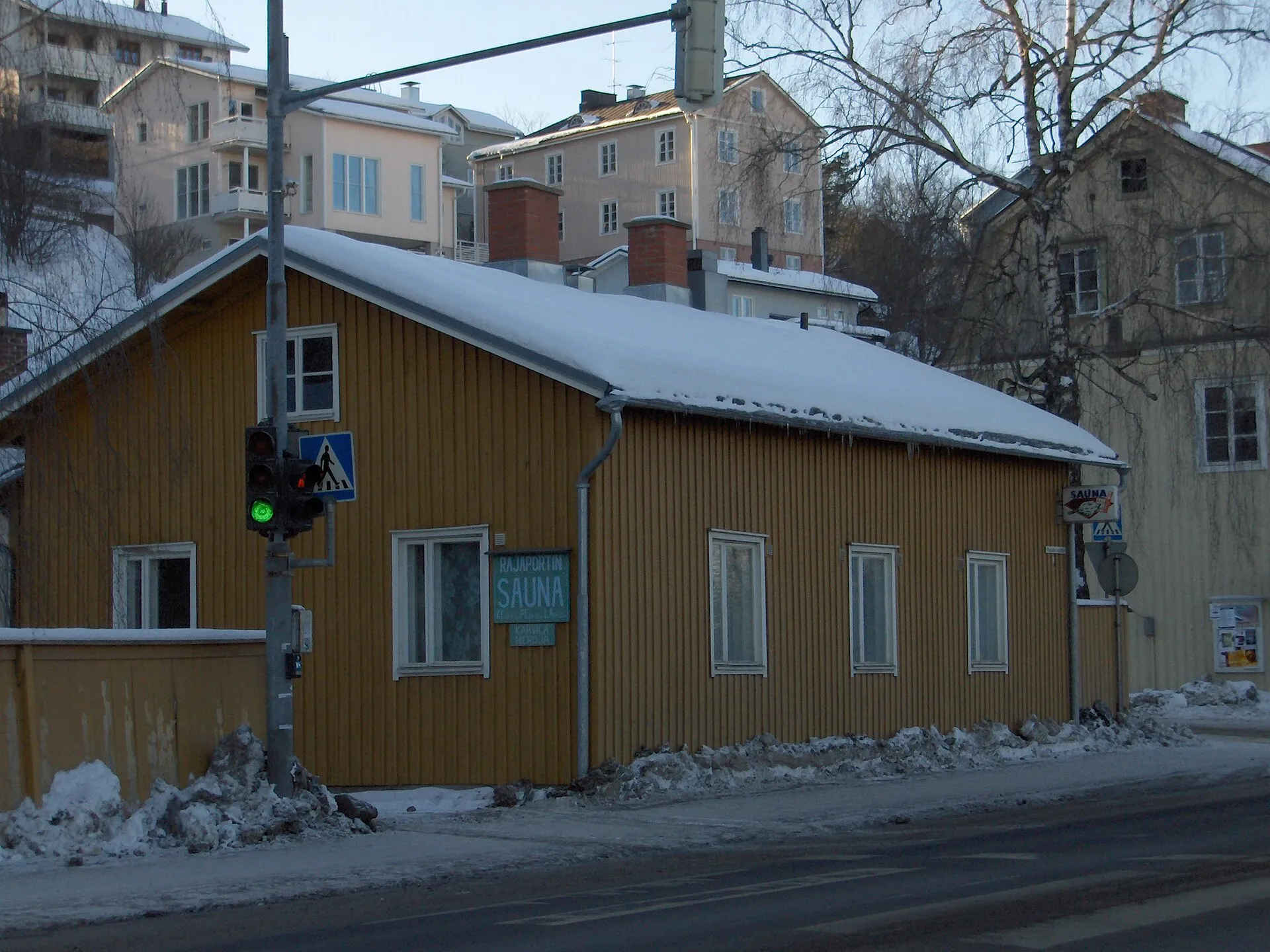
Rajaportti, in Pispala, Tampere: the oldest working public sauna in Finland is an ordinary building on an ordinary corner. Photograph: Visa580, CC BY 2.5, via Wikimedia Commons.

In each tradition, company is not a pleasant side effect. It is built into the format, and almost always into a physical detail:
| Tradition | What makes the format social |
|---|---|
| Japanese sentō | A neighborhood bath, minutes from home, used on the way back from work |
| Russian banya | The venik, the bundle of branches, needs a second person to be used |
| Hammam | The scrub is done by someone else, on the central heated stone |
| Korean jjimjilbang | The same uniform for everyone, a mixed common floor, food and a place to sleep |
| Finnish neighborhood sauna | Café, changing room and yard in the same building, on a weekly habit |
| Roman thermae | Exercise yard, gardens and shops attached to the bathing rooms |
Notice what none of them has: a booking slot and the door in sixty minutes.
When bathing became a thing you do alone
The Japanese case is the best documented, because somebody counted. According to figures from the national federation of public bathhouse businesses, compiled by Tokyo Shoko Research, Japan had 17,999 sentō in 1968. In 2022 there were 1,865, the 53rd consecutive year of decline. A drop of 89.6% in a little over half a century.
The cause is no mystery: the housing boom of the late 1960s put a tub inside the apartment. Bathing did not end. It moved off the street and into the home, where there is nobody to run into.
The second move is the one of the past few years, and it is the one that matters to anyone opening a space now. Bathing came back out of the house, but it came back as a product: a one-hour slot, a contrast protocol, a booking app, a measurable result. What is sold is the heat and the ice, not the room. That is the difference between a bathhouse and a contrast studio that we already separated in Bathhouse, spa, recovery and hot springs.
None of that is a mistake. A contrast studio solves the problem of someone who has an hour. It is simply not the same thing, and anyone who confuses the two on paper ends up building one and promising the other.
What heat does to conversation
The hot room produces a specific kind of company, and the reasons are far less mystical than the marketing suggests. There are six of them, all physical:
- The phone does not come in. Heat and humidity ruin the device, and almost every bathhouse bans cameras because people are undressed. It is probably the only room all week where nobody has anywhere else to look.
- The clothes come off, and status goes with them. Without shoes, a watch or a lanyard, the quick read of who is who gets much harder.
- The benches face forward, not each other. Talking side by side, looking ahead, costs less than talking face to face.
- The cycle forces a pause. Nobody takes two hours of heat in a row. The conversation does not happen inside the hot room: it happens in the break, in the rest area, in the yard, in the line for the shower.
- The discomfort is shared. Getting into cold water at the same time as a stranger is a known social shortcut, and it works in any language.
- There is time left over. A two or three hour visit has dead space by definition, and dead space is where conversation fits.
None of this is automatic, and silence is a legitimate choice too. The German Ruheraum is a declared quiet room. Japanese onsen etiquette asks for low voices. The question is not whether a house should be talkative or quiet: it is that the design settles it, and whoever does not decide ends up with the worst of both, an ambiguous room where half the people think they may speak.
What the research shows, and what it does not
Two bodies of literature get shuffled together here, usually in the copy of people selling saunas.
The first measures heat. The Finnish cohort studies track sauna frequency and duration against health outcomes. They do not record whether the person went alone or with three friends, so they say nothing about company.
The second measures social connection, and it is robust. The meta-analysis by Holt-Lunstad, Smith and Layton published in PLoS Medicine in 2010 pooled 148 studies and 308,849 participants and found a 50% greater likelihood of survival among people with stronger social relationships, an effect on the order of well-established risk factors. In June 2025 the World Health Organization published the report of its commission on social connection, which estimates one in six people worldwide experiencing loneliness and links isolation and loneliness to roughly 871,000 deaths a year.
What does not exist, as far as we know, is a study comparing bathing in company with bathing alone and producing a number. Anyone quoting that number is making it up. What does exist is this: a format that delivers heat and a public room at the same time, and strong evidence that the second part weighs on health as much as the first. For a space that has already built the hot room, the social part is the only benefit available for free.
The design settles whether people talk
For anyone drawing a space, company is not solved by a sign asking people to speak to each other. It follows from decisions about plan, program and price list, nearly all of them taken before construction.
| Decision | What isolates | What connects |
|---|---|---|
| What you sell | A 60 minute slot per person | Entry with an open-ended stay |
| Area split | Rest area smaller than the heat area | Rest area equal or larger |
| Hot room bench | Rows facing the stove | A continuous L or U bench |
| Temperature | 100 °C dry, which silences the room | 75 °C to 85 °C with steam, which lets people stay |
| Program | Free circuit all the time | One timed ritual that gathers the house in one room |
| Food | None | Coffee, tea or a simple kitchen with a table |
| Zones | An implied rule of silence | A quiet room and a talking room, signposted |
| Circulation | Changing room with a door straight to the street | A route that passes through the lounge |
| Price | Expensive drop-in only | A membership or a pass, which creates frequency |
The right-hand column costs money, and it is worth reading as investment rather than decoration. A large rest area is square meters that neither heat nor filter anything and still need finishing, and it is what turns a one-time visitor into a weekly regular. The cost ranges per square meter are in How much it costs to build a bathhouse.
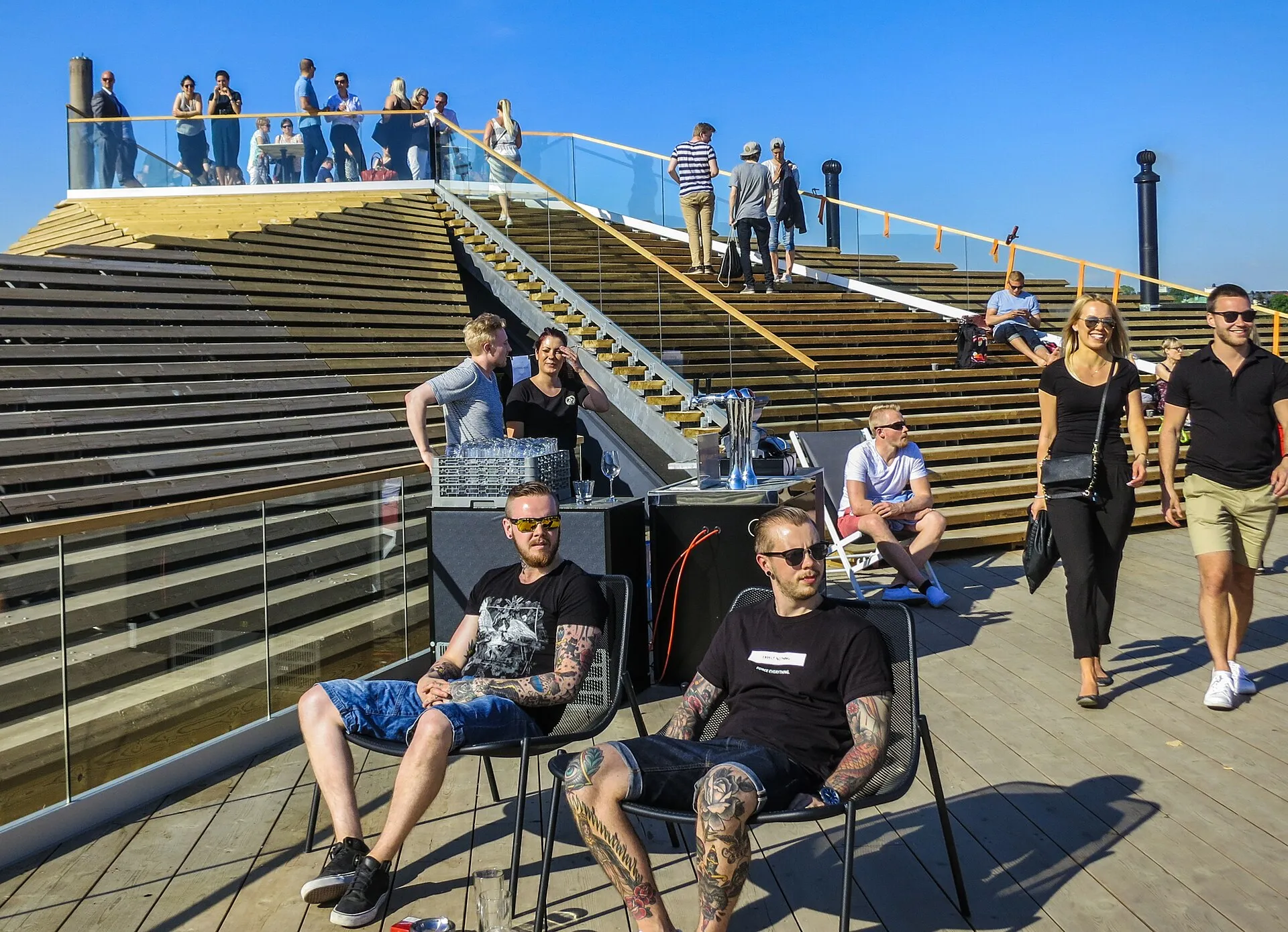
The terrace at Löyly, a public sauna on the Helsinki waterfront: the roof is grandstand seating, and the lounge is larger than the heat area. Photograph: Ninara, CC BY 2.0, via Wikimedia Commons.
.jpg)
How to go alone and not be alone
On the other side of the counter the arithmetic is simpler. Six practical rules:
- Going alone is the normal case. Most people in any bathhouse in the world arrived on their own. It is not a situation to be fixed.
- Ask at the desk which rooms are quiet rooms. Every house has the rule; almost none writes it on the door.
- Do not start a conversation in the hot room with someone whose eyes are closed. The rest area, the yard and the line for the shower are where people talk.
- Repeat the time slot. A bathhouse works like a neighborhood gym: what builds a tie is showing up on Tuesday night three weeks running, not one perfect visit.
- Bring someone on the second visit, not the first. On the first you are still working out where things are.
- Leave the phone in the locker. It is the one object capable of cancelling all five items above.
The rest sorts itself out. That is what the format was built for, and it has been in testing for about two thousand years.
Next step: open the map and look for a space near you with a real lounge, or read Bathhouse, spa, recovery and hot springs to know which format you are booking before you pay.